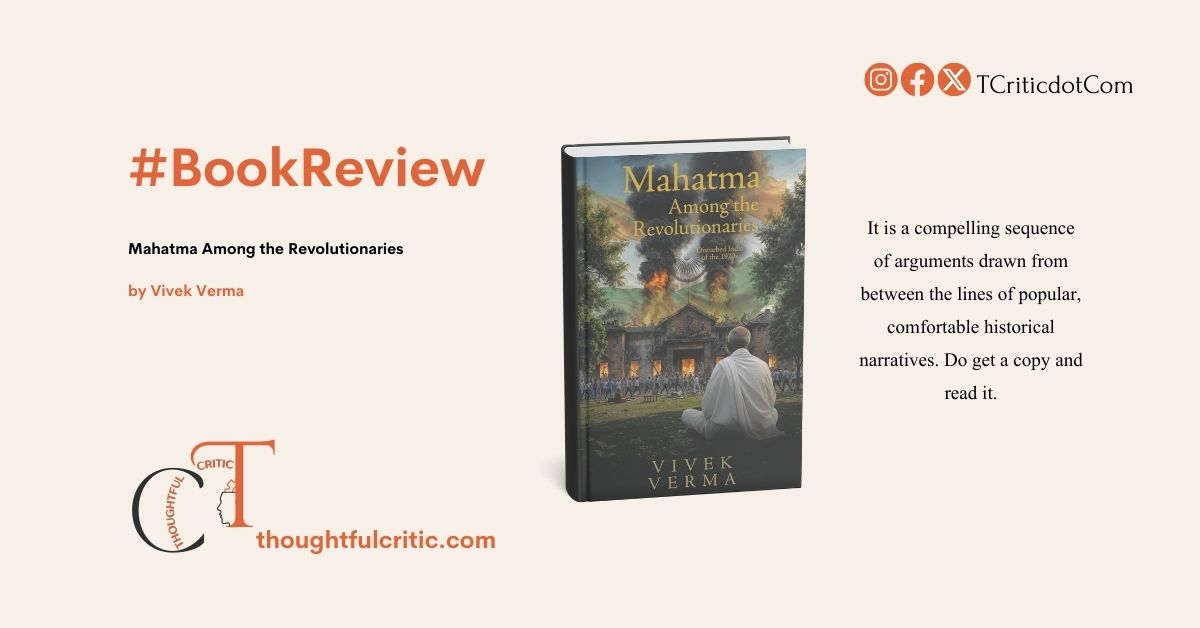
Mahatma Among the Revolutionaries is not a book that seeks to settle old arguments about India’s freedom struggle; rather, it unsettles them with purpose. Vivek Verma writes with the assurance of someone deeply familiar with both archival material and the emotional grammar of political movements. The result is a work that refuses to privilege comfort over truth. From the very beginning, the book signals that it will not conform to the sanitised binaries through which the nationalist past is often narrated. Instead, it insists that the story of India’s independence can only be understood by listening carefully to voices that spoke in radically different registers, sometimes even speaking past one another, yet all addressing the same condition of subjugation.
One of the book’s earliest strengths lies in its framing of the long prehistory of colonial domination. By invoking Alivardi Khan’s warning that “the Europeans were like bees; they would make me honey if left in peace but would sting an intruder to death,” Verma reminds the reader that colonial catastrophe was not born of ignorance alone, but of calculated hesitation. This line, deceptively simple, captures the tragic logic of accommodation that allowed European trading companies to entrench themselves irreversibly. It establishes a pattern that recurs throughout the book: moments where restraint, patience, or faith in gradualism are shown to have consequences that later generations must confront with far harsher tools.
The sections dealing with early revolutionary thought are among the book’s most bracing. When Verma quotes Savarkar’s assertion, “Only because you deny us a gun, we pick up a pistol,” he does not present it as mere provocation or rhetorical excess. Instead, the line is situated within a political environment where constitutional avenues were deliberately foreclosed. Violence, in this telling, is not romanticised, but neither is it dismissed as an aberration. It is treated as a language that emerges when other forms of speech are systematically rendered meaningless. This approach allows the reader to grasp why men like Madanlal Dhingra could declare, without irony or hesitation, that they wished to be “reborn of the same mother” to die repeatedly for the same cause. Verma is careful not to aestheticise martyrdom, yet he also does not strip it of its moral seriousness.
What makes the book particularly compelling is its refusal to isolate revolutionary violence as a fringe phenomenon. The Ghadr Party’s incendiary rhetoric, including the infamous advertisement promising “Salary: Death. Reward: Martyrdom and Freedom,” is not treated as reckless fantasy. Instead, it is analysed as a deliberate attempt to invert colonial notions of reward and punishment. Similarly, Har Dayal’s chilling prediction that “rifle and blood will be used for pen and ink” is presented as a bleak diagnosis of political communication under empire. Verma makes it clear that these were not metaphors born of intoxicated nationalism, but responses to a regime that understood force far better than argument.
Against this backdrop, Gandhi’s entry into the narrative is rendered with unusual clarity. Verma does not retroactively sanctify Gandhi’s early years. By quoting from the Green Pamphlet, where Gandhi demands to be treated “as Indians and as Britons,” the book foregrounds an uncomfortable truth: Gandhi’s early political vocabulary still operated within imperial assumptions. This honesty strengthens rather than weakens the portrait. It allows the reader to see Gandhi’s evolution as intellectual labour rather than moral inevitability.
One of the most striking moments in the book is Gandhi’s speech at Banaras Hindu University, where he openly acknowledges the presence of “an army of anarchists” and questions why Viceroy Hardinge should be protected from popular anger. The audacity of saying, “If we are to receive self-government, we shall have to take it,” in a hall filled with princes and colonial officials is not overstated. Verma understands that this moment marks a crucial convergence: Gandhi publicly recognises the revolutionary impulse even as he rejects its methods. This acknowledgement complicates the common portrayal of Gandhi as fundamentally detached from militant politics. He was not ignorant of revolutionary anger; he was responding to it, negotiating with it, and at times, restraining it.
The book’s treatment of British hypocrisy is equally unsparing. The parody song mocking the “mild Hindoo” reveals a racial cynicism that coexisted comfortably with imperial rhetoric about loyalty and civilisation. This context makes General Dyer’s admission that he intended to spread terror across Punjab appear not as an anomaly but as a crystallisation of colonial logic. Verma’s use of Dyer’s own words, “I wanted to reduce their morale,” is devastating precisely because it requires no embellishment. Churchill’s condemnation that “frightfulness is not a remedy known to the British pharmacopoeia” is shown to be morally significant yet politically insufficient. The massacre had already altered the psychological landscape irreversibly.
As the narrative moves into the late 1920s, the book captures the rising pitch of confrontation with remarkable control. The chant “Go back, Simon” is not treated as a mere slogan but as a collective assertion of political adulthood. Lala Lajpat Rai’s warning that violent revolution would be the government’s responsibility if repression continued is presented as prophecy rather than threat. His death, followed by the HSRA’s justification that killing Saunders was “a necessity,” marks a point where moral ambiguity becomes unavoidable. Verma does not excuse the act, but he insists that it be understood within the logic of vengeance, grief, and political signalling.
The phrase “It needs explosions to make the deaf hear” becomes, in Verma’s hands, less a justification of violence than a critique of imperial deafness. Bhagat Singh’s act in the Assembly is analysed as theatre, pedagogy, and protest rolled into one. The smoke bombs were meant to arrest attention, not to kill, and Verma is careful to preserve that distinction without downplaying the gravity of the act. Jawaharlal Nehru’s declaration that “India is a nation on the march” is then shown as an attempt to translate revolutionary impatience into mass politics, bridging the gap between elite leadership and popular momentum.
Gandhi’s Salt Satyagraha receives a treatment that avoids hagiography. When Gandhi writes, “On bended knee, I asked for bread and received a stone instead,” Verma reads it not as self-pity but as strategic clarity. The rejection of the eleven demands makes confrontation inevitable. Gandhi’s call urging women to guard illicit salt “as she would hold to her fond child” is interpreted as a radical reimagining of domesticity as political resistance. Non-violence here is neither passive nor gentle; it is emotionally charged, defiant, and deliberately disruptive.
The Chittagong Armoury Raid is narrated with a similar balance. Surya Sen’s invocation that “the first act of resistance is always premature” is treated as a sober acknowledgement of risk rather than romantic bravado. Verma resists the temptation to judge the raid solely by its outcome. Instead, he situates it within a global revolutionary ethos that valued symbolic rupture as much as tactical success.
The book’s closing movement, culminating in Subhas Chandra Bose’s anguished rejection of the Gandhi-Irwin Pact, is perhaps its most emotionally charged section. Bose’s declaration that “between us and the British government lies an ocean of blood” captures the depth of generational betrayal felt after the executions of Bhagat Singh, Sukhdev, and Rajguru. Verma does not attempt to reconcile Bose’s rage with Gandhi’s pragmatism. He allows the rupture to stand, recognising it as one of the defining fractures of the freedom struggle.
What ultimately distinguishes Mahatma Among the Revolutionaries is its refusal to resolve history into moral comfort. Verma understands that independence was not the product of ideological purity, but of relentless pressure applied from multiple directions. Non-violence and violence were not sequential stages; they were simultaneous forces, often in tension, occasionally in dialogue, and collectively destabilising. This book offers not a synthesis, but a reckoning. It demands that the reader accept that the road to freedom was paved with contradiction, courage, error, sacrifice, and unresolved grief. In doing so, it restores seriousness to a past that has too often been simplified for reassurance rather than understood for its complexity.
If you want to read this thought-provoking non-fiction piece, you may get a copy from Amazon India now – click here to get one.
Review by Amit Mishra for the Thoughtful Critic platform
Thanks for reading!
Mahatma Among the Revolutionaries by Vivek Verma
-
Thoughtful Critic's Rating
Summary
This book brings to you the layers of the history of the Indian freedom struggle that you might have ignored thus far… it is a compelling sequence of arguments drawn from between the lines of popular, comfortable historical narratives. Do get a copy and read it.