
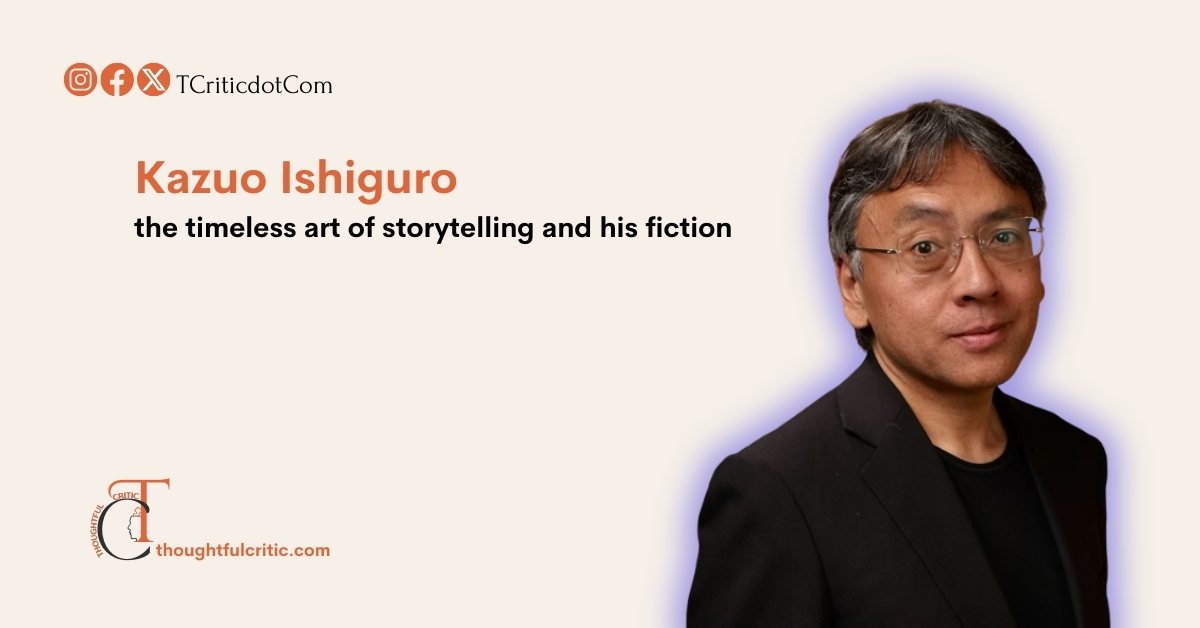
Kazuo Ishiguro’s novels occupy a rare space in contemporary literature because they combine emotional restraint with extraordinary depth. His fiction seems simple on the surface, yet it unfolds with an intensity that reveals itself slowly and with great precision. Ishiguro’s writing does not rely on dramatic plot twists or ornate language. Instead, it works through careful understatement, subtle shifts of memory, and characters who struggle to speak truths that lie just beyond their reach. This distinctive mode of storytelling gives his novels a lingering effect that grows clearer as the reader reflects on what has been left unsaid. The quietness of his narrative voice becomes a powerful instrument for exploring loss, longing, and the fragile dignity of human aspiration.
One of the most remarkable qualities of Ishiguro’s fiction is his mastery of unreliable narration. His narrators often speak with confidence but reveal gaps, hesitations, and contradictions that gradually build emotional tension. In The Remains of the Day, Stevens, the butler, recounts his memories with formal precision and professional pride, yet his narrative repeatedly exposes the cost of his emotional discipline. His loyalty to Lord Darlington, his inability to express affection, and his quiet participation in historical wrongdoing emerge through what he avoids saying rather than what he confesses. Ishiguro has an exceptional ability to let a character reveal emotional truth through silence. The reader becomes a partner in the act of interpretation, piecing together what is hidden beneath the polite surface of his narrators’ words.
Another defining feature of Ishiguro’s fiction is the way he handles memory. His novels often move gently between past and present, not through abrupt transitions but through associative links that mimic the flow of human recollection. Memory, in his books, is rarely stable. It shifts according to desire, guilt, fear, or the need to protect oneself from pain. This creates a narrative texture that feels profoundly true to emotional experience. In The Unconsoled, memory becomes a dreamlike structure that reflects the protagonist’s anxiety and confusion. In Never Let Me Go, memory assumes a protective role as Kathy H. attempts to make sense of a childhood shaped by secrecy and limited knowledge. The subtle distortions of memory allow Ishiguro to examine how people construct their identities and how they cope when the truth threatens their sense of self.
Ishiguro’s prose style is another reason his novels feel so distinctive. His language is calm, measured, and almost minimalist. He avoids elaborate metaphors and rhetorical flourishes, choosing instead to write in clear sentences that carry emotional weight through suggestion rather than exposition. This restraint mirrors the inner lives of his characters, who often struggle to articulate their deepest desires. The simplicity of Ishiguro’s prose should not be mistaken for a lack of complexity. Instead, it is a deliberate method that encourages readers to listen attentively. His fiction creates a quiet space where small gestures, half-spoken thoughts, and understated observations carry immense significance. The emotional impact arises not from dramatic declarations but from the slow revelation of inner conflict.
Read more: Must Read Novels by Asian Authors
One of the most compelling qualities of Ishiguro’s work is his ability to use genre in innovative ways. He does not write within a single tradition. Instead, he adopts the structures of mystery, dystopia, historical fiction, science fiction, or psychological drama and reshapes them to explore moral questions. Never Let Me Go uses the framework of speculative fiction but focuses less on scientific explanation and more on the emotional lives of characters who sense their destiny yet seek beauty in the time they have. The Buried Giant draws on the surface of a mythic journey to explore memory, trauma, and the cost of forgetting. Ishiguro treats genre as a tool rather than a limitation. He uses familiar forms to carry readers into unfamiliar emotional territory, often surprising them with the depth of the questions he raises.
A distinctive hallmark of Ishiguro’s fiction is his attention to dignity. His characters often live within social or institutional systems that limit their autonomy. Whether it is a butler in a traditional English household, clones raised for organ donation, or elderly travellers seeking their lost memories, Ishiguro’s characters hold onto dignity as their last source of meaning. This focus on dignity allows him to explore the quiet heroism of ordinary lives. His characters do not fight grand battles or make triumphant speeches. They persevere through uncertainty, hope, and disappointment with a kind of moral grace. Ishiguro’s understanding of human vulnerability gives his novels a compassionate spirit that resonates deeply with readers who recognise the same fragile determination within themselves.
Ishiguro is also skilled at exploring the politics of emotional suppression. In many of his novels, characters are trained to hide their feelings to conform to social expectations. Stevens suppresses his emotions to maintain professional decorum. The students at Hailsham refrain from discussing their eventual fate because the institution moulds them into silent acceptance. Even the characters in An Artist of the Floating World must confront the painful consequences of denial rooted in national trauma. Ishiguro uses these patterns of suppression to examine how societies shape individuals, and how individuals attempt to reclaim their private selves within those restrictions. The conflict between socially sanctioned silence and personal truth lies at the heart of many of his most powerful scenes.
Timing is another element Ishiguro handles with remarkable finesse. His narratives often move toward revelations that arrive gently rather than through dramatic climax. The significance of these revelations grows through emotional accumulation. Readers feel the weight of what has been withheld, and when the truth finally emerges, it resonates with profound intensity. The end of Never Let Me Go is painful, not because of surprise but because of inevitability. The end of The Remains of the Day carries a quiet heartbreak that feels more powerful than any dramatic confession could have achieved. Ishiguro understands that tension grows strongest when the reader senses an emotional truth long before the narrator is willing to acknowledge it.
Another strength of Ishiguro’s work is his ability to engage with moral ambiguity. He does not present his characters as purely innocent or purely guilty. Instead, he allows them to inhabit the grey spaces of human experience. Lord Darlington in The Remains of the Day is neither a villain nor a hero. He is a man who makes misguided choices in a complicated historical moment. The adults in Never Let Me Go believe they are doing something humane, yet they cannot escape the ethical contradictions of their world. Ishiguro resists the temptation to neatly resolve moral questions. He trusts his readers to grapple with ambiguity, and this trust gives his fiction a lasting ethical power.
In addition to these qualities, Ishiguro’s novels are marked by a profound sense of humanity. His works do not celebrate grand accomplishments or dramatic confrontations. Instead, they honour the quiet inner lives of individuals who struggle to understand themselves and their place in the world. His fiction suggests that human beings often make peace with limitations, sometimes gracefully and sometimes with sorrow. Yet even within these limitations, people seek connection, meaning, and belonging. This humane perspective sets Ishiguro apart from writers who rely on cynicism or despair. His novels acknowledge pain, but they also express tenderness for the flawed humanity at the centre of every life.
Another remarkable aspect of Ishiguro’s writing is his commitment to emotional honesty. His narrators may be unreliable, but the emotional truths that emerge from their stories are deeply authentic. Ishiguro’s characters often experience delayed recognition. They realise, too late, the significance of the people they loved, the choices they made, or the opportunities they missed. This delayed recognition creates a quiet tragedy that feels painfully familiar to many readers. Ishiguro does not blame his characters for their misunderstandings. Instead, he reveals the intricate ways in which people protect themselves from emotional pain until it becomes impossible to avoid.
Ishiguro’s influence extends far beyond literary technique. His novels speak to the contemporary world in profound ways. In an age when individuals often struggle with identity, memory, grief, and the pressure to perform socially acceptable versions of themselves, Ishiguro’s characters feel remarkably relevant. His exploration of institutional power in Never Let Me Go, and the ethical dilemmas it raises, has sparked conversations across fields ranging from education to bioethics. His portrayal of postwar Japanese society in An Artist of the Floating World continues to influence debates about cultural responsibility and national memory. His examination of emotional repression in Western social structures offers insights into the cost of maintaining dignity at the price of personal happiness.
Kazuo Ishiguro’s novels are special because they offer a quiet, compassionate, and profoundly thoughtful meditation on what it means to be human. His ability to blend emotional restraint with profound vulnerability creates a kind of storytelling that lingers in the mind long after the book is closed. He is a writer who trusts the reader’s intelligence and emotional insight. His fiction is a reminder that the most powerful stories do not always shout. Sometimes they whisper truths that grow louder with time.
By Anu for Thoughtful Critic
Thanks for reading!
..
—