
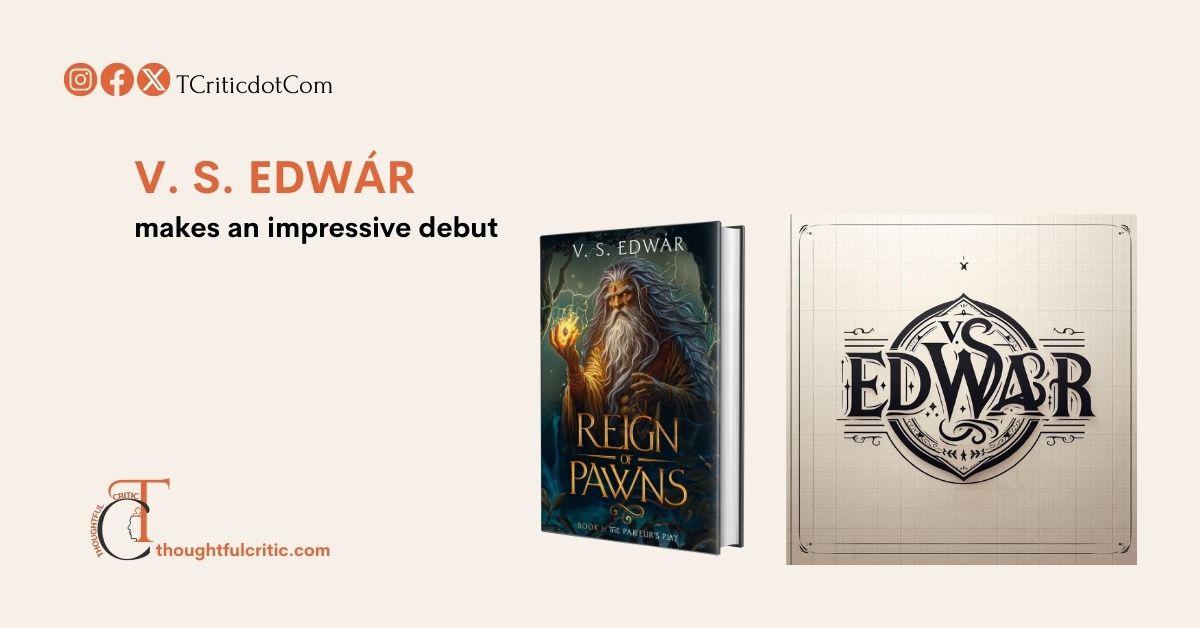
If you love authors like Dan Brown, Neil Gaiman and Amish Tripathi, you will surely like reading V. S. Edwár’s debut work, Reign of Pawns: Book 1 – The Parieur’s Play. These three writers represent very different territories in contemporary fiction. Dan Brown brings global intrigue and intellectual puzzles. Neil Gaiman carries myth into the modern world with quiet elegance and strangeness. Amish Tripathi reimagines Indian mythology for contemporary readers with reverence and immediacy. What makes Edwár’s entry into the literary arena fascinating is that he stands at an intersection where all three sensibilities overlap. His work has the ambition of an international thriller, the mystic pulse of mythological fiction, and the introspective tension of speculative storytelling. Readers who enjoy these authors will recognise something familiar in Edwár’s voice, yet they will also sense something distinctly his own.
Like Dan Brown, Edwár has an instinct for building intrigue from the first chapter onward. The novel does not rely on spectacle. It relies on craft. It relies on subtle signals and slow revelations. Brown’s fans will appreciate the global movement of the story. The novel shifts from London to Barcelona, from Paris to Houston, and then to Konark in India, but never loses narrative cohesion. The State Opening of Parliament scene is described with the same observational patience that Brown uses when placing readers inside grand institutions. Ethan’s voice during the broadcast tells us, “Our monarch travels from Buckingham Palace while the royal regalia is brought from the Tower of London,” and that simple line establishes a documentary clarity. Edwár understands that thriller readers enjoy realism even when a story prepares to step into deeper terrain. He builds trust first and then begins to widen the world.
Where Edwár resonates with Neil Gaiman is in the quiet strangeness that shadows the characters. Gaiman often creates worlds where myth is not separate from the present world but hidden within it, waiting for the right moment to surface. Edwár’s imagination works in a similar way. When Sánchez looks at the captives and asks, “Have mysterious things happened to you in the past—things that are impossible in this world?” the question feels like a doorway being cracked open. It hints that the novel is not only about a physical captivity but also about a metaphysical awakening. Fans of Gaiman will recognise the subtle invitation to consider what lies beneath the surface of ordinary life. The cyclone in Konark is another example. The appearance of Ushvatthama and Aroon inside a glowing sphere at the heart of the storm has the atmosphere of myth rising to reclaim its space in a modern world. It is the kind of moment that Gaiman’s readers enjoy: a collision between the everyday and the cosmic.
For readers who follow Amish Tripathi, the mythological resonance will be the strongest pull. Edwár does not retell mythology in a direct sense. Instead, he allows the stories of the Mahabharata to become reflections within the modern narrative. Sánchez’s retellings of Ganga, Shantanu, Satyavati, and their descendants are offered not as exposition but as moments where the emotional world of the captives deepens. When he describes the opulence of ancient Hastinapur with the line, “Drenched in marble, silk, and gold, the royal palace was like none ever built,” there is a sense that the ancient world is not being introduced from outside the narrative but from beneath it. Tripathi’s readers will appreciate the reverence with which these stories are told and the way they speak to questions of destiny, power, and identity.
Edwár’s style is grounded not only in narrative ambition but in psychological depth. His characters are caught between confusion and awakening. They wrestle with their own identities as much as with their circumstances. A line like “The most important thing is that you are not ordinary. All of you know that there’s something special about each of you” reflects his interest in the private struggles of his characters. This emotional interiority keeps the reader invested and creates a resonance with those who appreciate character-driven fiction. It also aligns him with authors who write myth not only as a story but as psychology.
Another small yet powerful moment illustrates how Edwár weaves strength into vulnerability. “A wise girl knows when to fight and when to get others to fight for her.” This sentence, spoken quietly and without flourish, carries the moral clarity and understated courage that remind readers of strong female voices in modern mythological fiction. It shows that the author is not only concerned with cosmic forces but also with personal strength, individual battles, and the subtle transitions between fear and resolve.
Readers who enjoy Brown, Gaiman, or Tripathi often share a particular curiosity. They like stories that expand the boundaries of the everyday. They want novels that ask questions rather than giving simple answers. They want suspense, but they also want meaning. Edwár writes with this sensibility. He invites readers to look beyond the events of the plot and into the deeper patterns beneath. His narrative moves steadily, without unnecessary haste, as if he is laying down pathways that will lead to a much larger world in the sequels. This sense of intentional architecture is something that fans of these authors will respect.
Goodreads reviewers have responded to these qualities with enthusiasm even before the book’s formal release. They speak of the emotional tension of the captivity scenes, the atmospheric beauty of the Konark cyclone chapters, and the satisfying interplay between myth and contemporary intrigue. Several have pointed out that the novel maintains a slow burn that keeps the mind active. Others praise the blend of cultures, locations, and eras. What they agree on most is that Edwár seems to have stepped into his debut with a voice that feels seasoned rather than tentative.
If you enjoy the symbolic clues and global stakes of Dan Brown, the mythic quietness and enigmatic wonder of Neil Gaiman, or the cultural depth and spiritual energy of Amish Tripathi, then Reign of Pawns will feel like a natural home for your reading sensibilities. Edwár has crafted a story that walks confidently between these worlds while building its own identity. His imagination is bold, his writing is thoughtful, and his commitment to narrative depth makes him a writer worth watching from the very beginning of his journey.
You can secure your copy on Amazon India – click here to get one!
Article by Rupesh for Thoughtful Critic
__