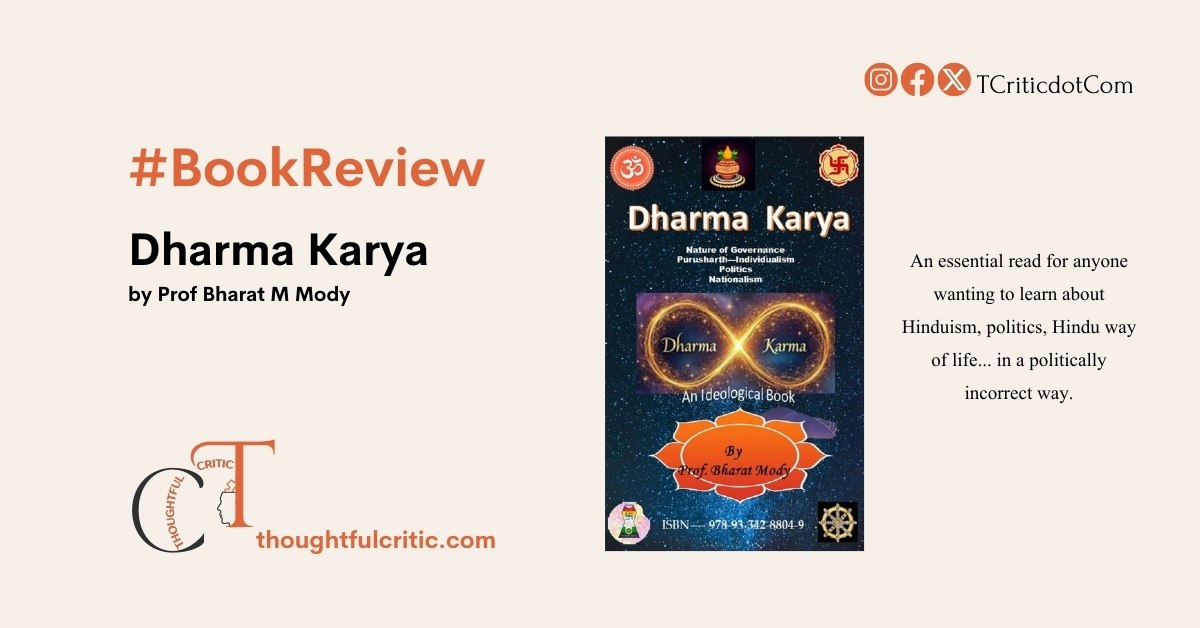
Prof. Bharat M. Mody’s DHARMA KARYA: An Ideological Book invites readers into a world of thought that is rooted in deep concern for the direction of modern society and a sincere desire to revive a more conscious and meaningful way of living. What strikes the reader first is not the polemical force of the book, which is undoubtedly present, but rather the author’s underlying emotional investment in the idea of national rejuvenation. The work reads like the outcome of years of reflection by someone who has watched India’s evolution and felt compelled to articulate a philosophy that could restore a sense of purpose and harmony to public life. It speaks to readers who think that the rapid shifts in culture, governance, and values have created confusion and fragmentation in society. For them, the book offers a voice that insists on clarity and rootedness.
One of the most engaging aspects of the book is the way the author treats philosophy as something alive rather than abstract. He does not write about it as an intellectual exercise removed from daily life. Instead, he shows how philosophical ideas shape everything from the structure of governance to how individuals understand themselves. His insistence that a nation must have an underlying philosophical compass stems from a very human longing for coherence. Without such grounding, he believes a society becomes reactive, directionless, and vulnerable to ideological drift. This approach makes the book relatable to readers who may not be trained in philosophy but feel intuitively that the world around them has lost moral orientation.
Although the book addresses prominent themes such as governance, civilisation, and ethics, the writing often feels personal. The author speaks with the conviction of someone who has witnessed what he considers the slow erosion of India’s intellectual independence. His reflections are not presented through academic distancing but through a tone that suggests emotional investment in the country’s future. This human element gives the book an earnest quality. Even when the arguments are strong, the reader hears the underlying plea for national renewal rather than a detached scholarly critique. It is this emotional thread that helps sustain the book’s momentum.
A particularly refreshing aspect of the book is its attempt to bring ancient Indian worldviews into conversation with contemporary anxieties. The author presents ancient Indian thought not only as a heritage treasure but as a living reservoir that can address modern dissatisfaction. Instead of describing ancient India in grand or romanticised terms, he emphasises that earlier generations saw the world differently and that their ways of thinking fostered a sense of inner steadiness that many people today find missing. He appeals to readers who feel overwhelmed by the speed of modern life and suggests that the calm, reflective, and balanced worldview of earlier Indian traditions can offer psychological grounding.
Another notable strength is the author’s ability to connect ideas across time. He speaks of concepts that date back centuries but frames them in ways that resonate with current debates on identity, social cohesion, and the purpose of governance. While many books on ancient Indian thought are content to describe the past, DHARMA KARYA presents the past as a dynamic presence. It is not simply a memory but a source of possibilities. This ability to make ancient wisdom feel contemporary gives the text a sense of relevance that will appeal to young readers navigating questions of belonging in a rapidly changing world.
The book also attempts to show how moral clarity at the individual level contributes to clarity at the national level. Prof. Mody argues that individuals cannot expect ethical governance if they do not cultivate ethical habits themselves. This connection between inner discipline and societal order is one of the book’s more humane aspects. Rather than reducing governance to technical structures alone, he reminds readers that governance ultimately reflects the character of those who participate in it. Readers will find this emphasis on personal responsibility relatable, especially in a time when public discourse often avoids introspection and instead externalises blame.
One of the book’s more subtle contributions lies in its reflections on human motivation. The author recognises that people today feel conflicted between their personal aspirations and their cultural identities. He offers reassurance by insisting that personal growth and cultural loyalty are not in conflict if approached through a reflective framework. This encourages readers to explore questions about who they are and what values they want to hold, without feeling they must reject modern life to embrace tradition. The book’s guiding tone is one of integration rather than exclusion. Rather than asking readers to choose between ancient and contemporary worlds, it asks them to consider how these worlds can inform each other.
Readers may also appreciate the author’s concern for how India represents itself to the world. He writes with a mixture of pride and protectiveness, wanting India to regain intellectual self-confidence and to contribute ideas rather than merely adopt them. He believes that India has long been reacting to global narratives instead of generating its own. This sense of a lost voice resonates with many readers who feel that, despite its achievements, the country has not fully articulated its civilisational identity on the world stage. The book offers them a framework for thinking about how India can step into a role of intellectual leadership with authenticity.
Another distinctive feature of the book is its treatment of history not as a linear sequence of events but as a series of turning points where ideas either strengthened or weakened a civilisation. The author pays attention to emotional and cultural consequences rather than only to political outcomes. He portrays historical shifts as moments that shaped how people viewed themselves. This style helps readers relate to history more personally. Instead of feeling distant, history becomes a story about how human choices, values, and vulnerabilities determine long-term outcomes. The book may inspire readers to take a renewed interest in history as a source of moral insight rather than a list of dates and events.
The emotional core of the book rests on the idea that a civilisation is not destroyed by external forces alone but also by internal confusion. This is where the author’s concern feels most genuine. He wants readers to feel the weight of responsibility for shaping their own society. He believes that confusion arises when people forget the principles that once gave their culture coherence. By reminding readers of these principles, he seeks to revive a sense of unity and shared purpose. This sentiment, though not stated in sentimental language, permeates the book.
The language throughout the text tries to awaken conviction rather than simply inform. Prof. Mody wants his readers to feel that reconnecting with India’s philosophical roots is not a luxury but a necessity. Even when the arguments are forceful, the reason behind them comes from a desire to see people recover a sense of dignity in their cultural identity. The book, therefore, functions as a guide for readers seeking not only intellectual clarity but emotional grounding. It offers them the possibility of belonging to a civilisation that has meaning beyond the material conditions of the present.
What ultimately makes DHARMA KARYA worth reading is the author’s sincere belief that ancient Indian wisdom can help modern individuals cultivate a more thoughtful and fulfilling life. He is not trying to preserve the past as a museum piece. Instead, he is trying to revive a way of thinking that can anchor human life amid uncertainty. His message encourages readers to see themselves as participants in a long civilisational journey rather than as isolated individuals reacting to immediate circumstances. This broader sense of identity gives the book a quiet sense of upliftment, even when its arguments are strong.
In its essence, DHARMA KARYA is a call for conscious living. It asks readers to reconsider what it means to be connected to a civilisation and how that connection can deepen their understanding of themselves. By encouraging reflection on ancient Indian wisdom without demanding blind acceptance, the book offers readers a valuable opportunity to reflect on their place in the world with renewed clarity. It stands as a meaningful contribution to contemporary Indian thought, inviting its audience to rediscover a philosophical heritage that can enrich their personal lives while strengthening the collective spirit of the nation.
Get a copy of this book from Amazon India – click here to know.
Review by Ashutosh for Thoughtful Critic