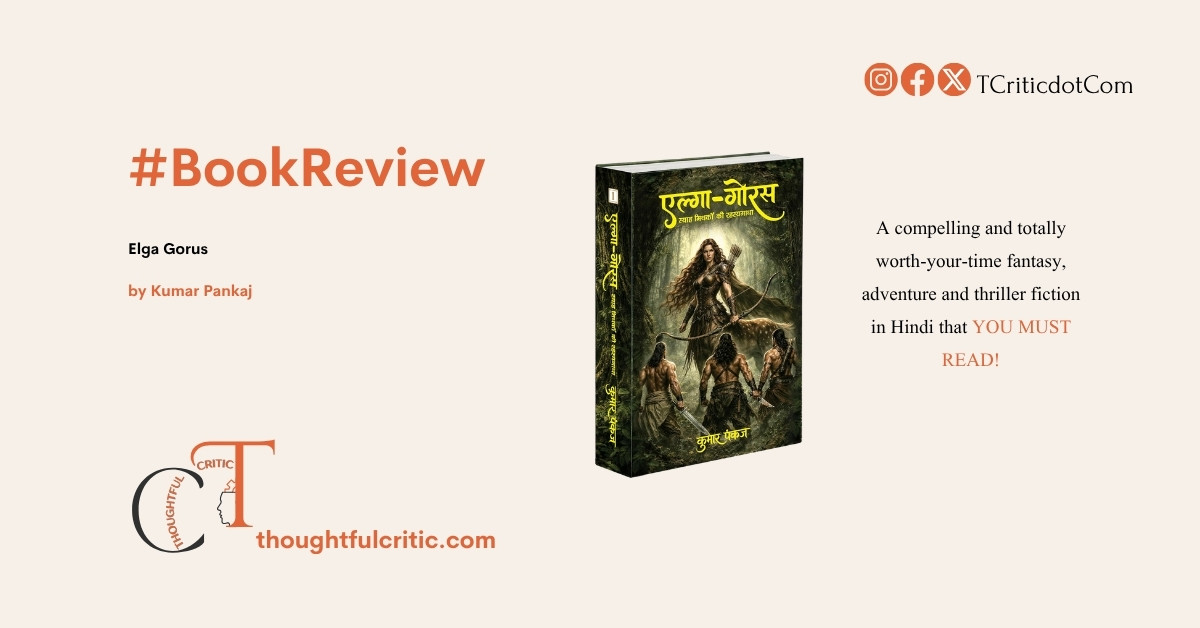
One of the most impressive aspects of Kumar Pankaj’s Elga Gorus is the sheer confidence with which it embraces imagination. Spread across two volumes, the novel does not merely tell a story; it invites readers into a vast and carefully constructed mythological universe filled with mystery, ancient knowledge, strange creatures, hidden histories, and extraordinary adventures. In an age when much of contemporary fiction tends to remain rooted in realism, Elga Gorus dares to dream on a much larger scale. From the very first pages, readers are introduced to a world where nothing is ordinary and where every cave, manuscript, creature, and journey seems connected to a larger cosmic mystery. The result is a reading experience that feels expansive and immersive. It is the kind of book that rewards curiosity and constantly encourages readers to explore further. Though I have read such novels before, as far as the theme and build-up are concerned, Kumar Pankaj’s work brings more to the table. Beyond a promising and indulgent theme, the novel also offers conversations and dialogues that are rare in such crafty and lengthy works of fiction. Once I began reading this book, I could seldom put it off and release myself from the gripping ropes of suspense, adventure, and the curiosity to know what happens further in the story. So, the first impressions will be encouraging, and readers will certainly take a dive into the strange world that keeps on getting more and more stranger with the development of the storyline.
Talking about the myth-making and composing fictional worlds, what makes the novel particularly engaging is its remarkable world-building. Kumar Pankaj demonstrates a rare ability to create locations that feel animated, relatable and alive. The mysterious caves, forgotten settlements, dangerous deserts, ancient ruins, and secret realms are not merely decorative settings. They possess atmosphere, history, and emotional weight. As readers move through the narrative, they begin to feel that these places exist beyond the pages of the book. The visual quality of the writing is one of the novel’s greatest strengths. Many scenes unfold with such clarity that they resemble sequences from a grand fantasy film. This vividness helps readers remain fully invested in the story and makes the fictional world feel tangible. It is difficult not to admire the level of imagination that has gone into constructing such a diverse and visually rich universe. Therefore, though you are fully aware that the world being discussed in the novel is mythical and imaginary, you fully commit to what you read and enjoy!
Discussing the world that the novelist has woven with his imagination might not be effective without telling about the characters. Yes, the characters represent another major achievement of the novel. Across both volumes, readers encounter a wide variety of personalities ranging from warriors and wanderers to mysterious beings and enigmatic figures whose motives remain hidden for much of the story. Despite the large cast, many characters leave lasting impressions because they are written with distinct identities and emotional depth. Rather than relying solely on spectacle or mythology, Kumar Pankaj ensures that the narrative remains anchored in the experiences, fears, ambitions, and struggles of its characters. This emotional grounding prevents the fantasy elements from becoming abstract. Readers gradually form attachments to various characters and become invested in their journeys. The novel succeeds because its world feels populated by individuals rather than merely by archetypes. Teenagers and young readers will especially enjoy this facet of the story.
Well, at times, voluminous works dissuade us from reading them. However, in this case, Kumar Pankaj has been able to pull off something that rarely succeeds! As remarkable as it is, another quality that deserves appreciation is the way the two volumes complement one another. The first volume functions as an invitation into the world of Elga Gorus. It establishes the mysteries, introduces the major characters, and lays the foundation for the larger mythology. The second volume then expands these elements significantly. The stakes become higher, the mysteries deeper, and the narrative even more engaging. Many readers may find the second volume particularly rewarding because it builds upon the emotional and narrative investment created earlier. Instead of simply extending the story, it enriches the mythology and broadens the scope of the adventure. Together, the two volumes create a complete experience that feels epic in scale while maintaining a strong narrative focus.
Though I was not sure when I completed the first volume, it was clear after I finished reading both volumes of Elga Gorus. The novel’s appeal across age groups is also worth highlighting. Younger readers are likely to be captivated by the adventures, magical elements, mysterious creatures, and continuous sense of discovery. At the same time, older readers will find themselves drawn to the symbolic dimensions of the story, its philosophical undertones, and its exploration of themes such as knowledge, power, destiny, courage, and sacrifice. This ability to function on multiple levels is one of the reasons the novel remains consistently engaging. Readers can approach it simply as an entertaining fantasy adventure or as a more layered exploration of myth and mystery. Few novels manage to offer both experiences simultaneously, and Elga Gorus deserves credit for achieving that balance.
The book is perhaps best enjoyed by readers who are willing to immerse themselves completely in its world rather than rush through it. This is not a novel that reveals all its secrets immediately. Much of its pleasure comes from gradual discovery. Readers who enjoy fantasy series, mystery fiction, mythology, and elaborate world-building are likely to find themselves especially drawn to it. It is the kind of story that works wonderfully during long weekends, quiet evenings, or extended reading sessions when one can fully surrender to the atmosphere the author has created. The deeper one ventures into the narrative, the more rewarding the experience becomes. The novel constantly offers new mysteries, new characters, and new dimensions of its mythology to explore.
Ultimately, Elga Gorus stands as an ambitious and memorable contribution to modern Hindi fantasy literature. Kumar Pankaj deserves considerable praise for creating a work that successfully combines the spirit of classic Hindi tilism and mystery fiction with contemporary fantasy storytelling. Its strengths lie in its vivid imagination, expansive world-building, diverse cast of characters, strong visual imagery, and ability to sustain curiosity across two substantial volumes. While the scale of the narrative demands attention and commitment from readers, those willing to invest themselves in its universe will discover a rich and rewarding literary journey. More than anything else, Elga Gorus succeeds because it rekindles a sense of wonder, and that is perhaps the most valuable gift any fantasy novel can offer.
You can get a copy of this novel in two volumes from Amazon India – click here to buy now.
Review by Abhinandan for Thoughtful Critic