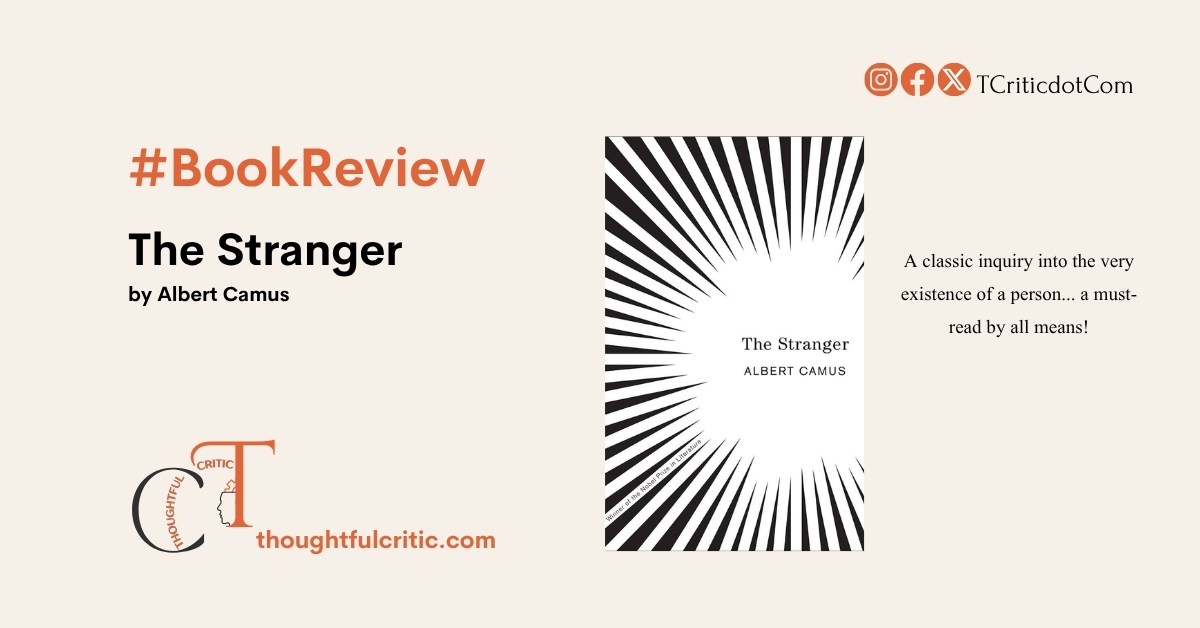
There are novels that tell stories, novels that illuminate societies, and novels that challenge philosophical assumptions. Albert Camus’s The Stranger belongs to a rarer category: it transforms a seemingly ordinary narrative into a profound inquiry into the nature of existence itself. Published in 1942, The Stranger (L’Étranger) remains one of the most discussed works of twentieth-century literature because it compels readers to confront questions they often prefer to avoid. What gives life meaning? Is morality inherent or socially constructed? Does emotional conformity determine our place within society? Can truth exist independently of social expectations?
Camus approaches these questions through a narrative that appears deceptively simple. The novel follows Meursault, an ordinary French Algerian clerk whose emotional detachment from conventional social values ultimately places him on trial not merely for murder, but for his refusal to perform the emotions society demands. What begins as a personal story gradually evolves into a philosophical drama about alienation, freedom, absurdity, and death.
The genius of The Stranger lies in the fact that it never lectures. Camus allows the philosophical implications to emerge naturally through action, observation, and silence.
The novel opens with one of the most famous lines in modern literature:
“Mother died today. Or, maybe, yesterday; I can’t be sure.” (p. 1)
From this opening sentence, Camus establishes the emotional and philosophical terrain of the novel. The statement is not cruel. It is not intentionally shocking. Rather, it is astonishingly factual. Meursault reports his mother’s death with the same neutrality with which he might report the weather.
This opening has often been misunderstood as evidence of Meursault’s heartlessness. A closer reading reveals something more complex. Meursault is not incapable of feeling. He simply refuses to manufacture emotions he does not genuinely experience. He exists outside the rituals through which society validates grief, affection, patriotism, religion, and morality.
The funeral sequence is among the finest examples of psychological realism in modern fiction. While others expect mourning, Meursault notices physical sensations. He thinks about the heat, the sunlight, the fatigue, the coffee he drinks, and the cigarettes he smokes beside his mother’s coffin. Camus repeatedly emphasises the material world. The scorching Algerian sun becomes almost a character in its own right. The funeral scene also introduces a recurring theme that dominates the novel: society judges appearances more harshly than actions. The residents of the nursing home observe Meursault. Later, the legal system will do the same. The fact that he does not cry becomes more significant than the facts of the crime he eventually commits.
Meursault is one of literature’s most enigmatic protagonists. Unlike Dostoevsky’s tortured intellectuals or Kafka’s anxious victims, he rarely reflects on abstract moral questions. He does not seek justification for his actions. He does not attempt to create elaborate narratives about himself. His relationships reveal this detachment.
Marie Cardona, perhaps the most sympathetic figure in the novel, genuinely loves him. Yet when she asks whether he loves her, his answer is disarmingly honest. He tells her that the question has little meaning and that he probably does not love her. When she later proposes marriage, he agrees, not because of romantic passion but because it makes no significant difference to him. This indifference is often mistaken for emotional emptiness. In reality, Meursault values physical experience over abstract sentiment. He enjoys swimming with Marie, sharing moments of intimacy, and experiencing sensory pleasures. What he rejects is the social obligation to attach grand meanings to these experiences.
Raymond Sintes serves as Meursault’s moral foil. Violent, manipulative, and self-serving, Raymond exploits others with little remorse. Yet society appears more comfortable with Raymond than with Meursault because Raymond understands social performance. He knows how to display expected emotions. Meursault, by contrast, refuses performance altogether.
Salamano and his abused dog form another important symbolic relationship. Their strange coexistence mirrors the human condition itself: attachment persists despite suffering. The old man’s despair after losing the dog reveals a depth of emotional dependence that contrasts sharply with Meursault’s apparent detachment. Yet Camus suggests that beneath their differences, both men confront the same existential loneliness.
The central turning point of the novel occurs on the beach. Here, Camus transforms a relatively simple event into one of literature’s most debated scenes.
The murder itself is remarkable for its lack of conventional motivation. Meursault does not kill because of hatred, revenge, ideology, or passion. The unbearable heat, the blinding sunlight, the glare of the knife, physical discomfort, and a sequence of accidental circumstances converge into a moment of irreversible violence. This scene has often frustrated readers seeking clear moral explanations. Yet that frustration is precisely Camus’s point. Human actions frequently emerge from contingencies rather than coherent narratives. Society craves explanations because randomness is terrifying.
The sun functions almost symbolically throughout this episode. It becomes an oppressive force, dissolving rational distinctions and overwhelming consciousness. The murder occurs less as a calculated act than as a collision between human vulnerability and an indifferent physical universe.
If the first half of the novel concerns the crime, the second half concerns society’s response to it. Here, The Stranger transforms into a devastating critique of judicial morality. The trial is not truly about the Arab whom Meursault kills. Instead, it becomes an examination of Meursault’s character. Witness after witness discusses his behaviour at his mother’s funeral. Prosecutors are scandalised by his failure to cry, his decision to watch a comedy the next day, and his relationship with Marie. The legal process reveals an uncomfortable truth: societies often judge people not according to what they have done, but according to whether they conform to accepted emotional norms. Camus exposes the theatrical nature of justice. The courtroom becomes a stage upon which competing narratives struggle for dominance. Facts matter less than interpretation.
Meursault himself recognises the absurdity of the proceedings. At one point, he observes the courtroom almost as an outsider observing a performance. The machinery of justice appears more interested in constructing a morally satisfying story than in understanding reality. This insight aligns closely with Camus’s broader philosophical concept of the absurd.
To understand The Stranger, one must understand Camus’s philosophy. However, it is important not to reduce the novel to a philosophical treatise. For Camus, the absurd arises from the confrontation between two realities: humanity’s desire for meaning and the universe’s silence. Human beings seek explanations, moral order, divine purpose, and ultimate significance. The universe offers none of these guarantees. The tension between our longing and reality’s indifference produces the absurd. Meursault embodies this condition more completely than most literary protagonists. He refuses comforting illusions. He does not invent meanings where none exist. He does not pretend to have certainty about God, morality, or destiny. This philosophical position reaches its climax during his confrontation with the prison chaplain. Faced with execution, Meursault rejects religious consolation. His rejection is not motivated by hostility toward faith but by a commitment to intellectual honesty.
The culmination of this awakening appears in one of the most celebrated passages in modern literature:
“…for the first time, the first, I laid my heart open to the benign indifference of the universe.” (p. 154)
This sentence encapsulates Camus’s worldview. The universe is indifferent, but that indifference need not produce despair. On the contrary, acceptance can become a source of liberation.
“And I ended by believing it was a silly thing to try to force one’s thoughts out of their natural groove.” (p. 141)
The novel’s final lines deepen this insight:
“…I realized that I’d been happy, and that I was happy still.” (p. 154)
This is perhaps the most paradoxical moment in the book. A condemned man awaiting execution discovers happiness precisely when he abandons illusions. Freedom emerges not from hope but from acceptance.
The intellectual richness of The Stranger becomes even clearer when compared with Camus’s other works. In The Myth of Sisyphus, Camus develops the philosophical framework that underlies The Stranger. The essay argues that one must imagine Sisyphus happy despite the apparent meaninglessness of his task. Meursault represents a fictional embodiment of this philosophy. Like Sisyphus, he confronts an indifferent reality without surrendering to despair.
In The Plague, Camus explores a different response to absurdity. Whereas Meursault accepts the universe’s indifference, Dr Rieux actively resists suffering through solidarity and moral action. The two works complement rather than contradict each other. Together, they suggest that awareness of absurdity can lead either to lucid acceptance or ethical engagement.
Compared with The Fall, another of Camus’s masterpieces, The Stranger appears almost innocent. Jean-Baptiste Clamence in The Fall is consumed by self-consciousness and guilt. Meursault possesses neither. If Clamence represents excessive self-awareness, Meursault represents radical authenticity.
The novel also, almost, compels an active reader to compare with several major works of world literature. The most obvious parallel is Franz Kafka’s The Trial. Both novels depict protagonists trapped within incomprehensible legal systems. Yet the differences are significant. Kafka’s Joseph K. never learns why he is accused, whereas Meursault knows exactly what he has done. Kafka’s world is nightmarishly bureaucratic; Camus’s world remains recognisably realistic. Kafka emphasises mystery; Camus emphasises clarity.
Dostoevsky’s Crime and Punishment provides another illuminating contrast. Raskolnikov commits murder and then undergoes profound psychological torment. Meursault experiences almost no guilt in the conventional sense. Dostoevsky explores redemption through suffering and faith. Camus explores freedom through acceptance and lucidity.
One may also compare Meursault with Roquentin in Sartre’s Nausea. Both characters confront existential alienation. Yet Sartre’s protagonist is intensely reflective, while Meursault remains resolutely concrete. Sartre intellectualises existence; Camus experiences it through sunlight, sea, heat, and physical sensation.
In a broader literary context, The Stranger can also be placed beside Herman Melville’s Bartleby, the Scrivener. Both Bartleby and Meursault resist social expectations through passive nonconformity. Neither launches a rebellion. Their refusal simply exposes the fragility of social conventions.
Stylistically, Camus achieves extraordinary effects through simplicity. His prose is stripped of ornament. Sentences are short, direct, and deceptively transparent. Yet beneath this apparent simplicity lies immense sophistication.
The narrative voice mirrors Meursault’s consciousness. Descriptions focus on surfaces, sensations, and immediate perceptions. Psychological analysis is largely absent. Readers must infer emotional and philosophical significance from what is not said as much as from what is said.
This technique creates a remarkable ambiguity. We never fully understand Meursault, yet we understand him intimately. The novel continuously oscillates between proximity and distance.
Such restraint distinguishes Camus from many modernist writers. Where James Joyce multiplies linguistic complexity, and Marcel Proust explores intricate memory, Camus pursues clarity. His prose resembles a clean blade whose sharpness becomes apparent only after it cuts.
What ultimately makes The Stranger enduring is not merely its philosophical significance but its unsettling relevance. Modern societies continue to reward emotional performance. Public life remains dominated by expectations concerning how individuals should grieve, love, believe, and express themselves. Meursault’s crime is not simply murder. It is authenticity carried to an uncomfortable extreme.
Camus never asks readers to admire Meursault uncritically. The protagonist can be frustrating, morally ambiguous, and emotionally distant. Yet he compels reflection because he exposes assumptions that most people rarely question.
More than eighty years after its publication, The Stranger remains one of the essential novels of modernity. It combines narrative elegance, philosophical depth, psychological complexity, and stylistic precision with remarkable economy. Few novels are simultaneously so accessible and so inexhaustible.
In the final analysis, The Stranger is not a novel about nihilism, as it is often described by scholars and critics. It is a novel about clarity. It strips away illusion after illusion until only mortality, consciousness, and the indifferent universe remain. Yet from this apparent desolation emerges a strange affirmation. Meursault’s acceptance of existence does not diminish life; it intensifies it. His acceptance is what inspires readers to understand the nature of life from a passive perspective. Could we alter anything at all? What is the role of an individual in a society designed by the very manifestation of many individualities coming together and pushing away those who dare to confront the collective consciousness?
Camus’s masterpiece endures because it confronts humanity’s oldest question without offering comforting answers. Instead, it offers something rarer: the courage to look directly at reality and still affirm life.
You can get a copy of this book from Amazon India – click here.
Review by Amit Mishra for Thoughtful Critic
The Stranger by Albert Camus: An Intellectual Book Review
-
Thoughtful Critic Rating
Summary
A compelling masterpiece that keeps you in a quandary!