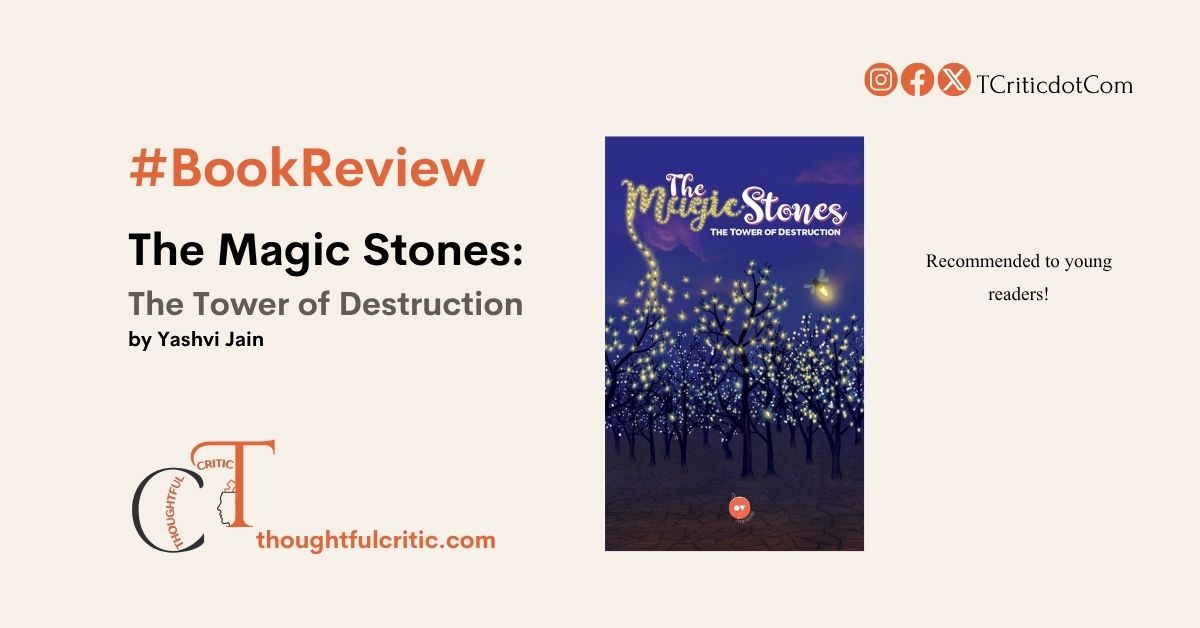
The Magic Stones: The Tower of Destruction by Yashvi Jain is the second book in a fantasy-adventure series that follows Flora Bennett and Rosy Kelly as they discover more about their abilities and become involved in a conflict much larger than their own lives. Published in 2023, the novel continues the story introduced in The Magic Stones: Dark Dreams. This time, the narrative moves beyond the initial mystery and takes the protagonists into Astrolen, a strange city threatened by the Dark Dreams organisation and its leader, Dolores. The girls must understand their powers, confront dangerous situations and attempt to save a population held under the control of an oppressive force. Doesn’t it sound interesting? As a work in the children’s literature genre, this novel promises a lot and delivers on many!
The magic stones also acquire greater significance, suggesting that their purpose extends beyond opening portals between places. Jain has clearly attempted to expand the scale of her fictional world in this instalment. The novel combines action, humour, friendship and questions about responsibility, while introducing new characters, locations and magical rules. Its main strength is the author’s willingness to develop her ideas rather than simply repeat the structure of the first book. However, the execution is uneven. The plot contains several interesting developments, but the writing sometimes moves too quickly, and the characters do not always receive enough space to respond meaningfully to the events around them. The result is an imaginative adventure that offers young readers plenty to follow, although it would benefit from tighter writing and more careful organisation.
The story begins with Flora and Rosy being drawn into a conflict involving the Dark Dreams. James, another character from the first book, also becomes involved in the unfolding events. The girls discover that the organisation is not what they had understood it to be, and they encounter Dolores, who intends to use Flora’s abilities for his own purposes. Flora refuses to cooperate, and she and Rosy are taken towards the Tower of Destruction. The tower is not simply a place of confinement. It represents the cruelty of Dolores’s rule, with prisoners forced to work under dangerous conditions. The conflict therefore becomes a question of survival as well as escape. Flora and Rosy must find ways to use their powers while learning more about the world into which they have been brought. The story also introduces the threat to Astrolen and the importance of the Astrolen gem. These developments give the novel a larger purpose than the protagonists’ personal safety. They must consider the fate of other people and decide whether to intervene even when doing so puts them at further risk. This is a useful direction for the series because it gives the characters responsibilities beyond their own immediate concerns. At the same time, the number of developments introduced in a relatively short narrative can make the plot difficult to follow. The story moves between discoveries, confrontations and explanations at speed. A clearer progression from one major event to the next would help readers understand not only what is happening but also why each development matters.
The expansion of the fictional setting is one of the novel’s more successful features. Astrolen is presented as a distinctive place, with unusual buildings, strange skies, and features that set it apart from the ordinary world. The description of glass buildings is particularly interesting because a character explains that glass represents truth and that the city’s inhabitants have nothing to hide. This detail gives the setting a clear idea behind its appearance. Jain also uses portals, magical stones and unfamiliar landscapes to create opportunities for discovery. These elements should appeal to readers who enjoy stories in which an ordinary situation opens into a world governed by different rules. The author is not short of ideas, and the second book shows a willingness to add detail to the fictional universe. However, adding new locations and magical objects also creates a need for clarity. Readers must be able to understand how these elements work and how they relate to the central conflict. At some points, explanations arrive alongside new developments, leaving little time for the reader to absorb the information. The story would be stronger if the rules of Astrolen and the function of its important objects were introduced more gradually. The setting has potential, but its effectiveness depends on how well the author connects its details to the action.
Flora remains the central character, and the first-person narration allows readers to follow events through her thoughts and reactions. She is curious, outspoken and willing to act when faced with danger. Her humour is a consistent feature of the narrative. Even when she is frightened or confused, she often responds with a joke or an exaggerated observation. This gives the book an informal tone and helps make the character accessible to younger readers. Rosy is an important companion in the adventure. She participates in the decisions and confrontations rather than remaining a passive observer, and her exchanges with Flora provide some of the lighter moments in the story. Their friendship gives the novel continuity and helps connect the magical events to familiar experiences of trust and cooperation. James also contributes to the developing conflict, although the central focus remains on Flora and Rosy. The main limitation is that the characters’ personalities are sometimes expressed more through dialogue and immediate reactions than through sustained development. Flora’s thoughts are frequently reported as events unfold, but the emotional effects of major discoveries are not always explored in depth. Rosy could also be given a more distinct personal perspective, with her own concerns and decisions receiving greater attention. Stronger character development would make the adventure more engaging because readers would have a clearer sense of how the events change the people experiencing them.
The treatment of magical powers is another important part of the novel. Flora already possesses telekinesis, but she gradually discovers that her abilities extend beyond what she initially understands. Rosy also develops her powers, and the characters begin to recognise that different abilities have different uses and limitations. The fact that using their powers can exhaust them is a useful detail. It prevents magic from becoming an effortless solution to every problem and allows the author to create situations in which the protagonists must consider the risks of acting. The discovery of new abilities also provides a reason for the story to continue beyond the first book. However, the development of a magical system requires consistency. Readers need to know what the characters can do, what they cannot do and what it costs them to use their powers. When abilities emerge suddenly during a crisis, the surprise can be effective, but too many such developments may reduce the tension if they appear to solve problems without sufficient preparation. Jain should therefore pay particular attention to the rules governing the magic in future instalments. A clear and consistent system would make the characters’ successes more convincing and their failures more meaningful.
The novel also raises questions about power, responsibility and the circumstances in which people make choices. The Tower of Destruction provides the clearest example. Prisoners are forced to work on a structure whose failure could put other lives at risk. Flora considers whether people in such a situation can genuinely choose between protecting others and preserving themselves. This is one of the more serious moments in the book because it moves beyond the simple aim of defeating a villain. It asks the reader to consider the conditions under which decisions are made. The situation also gives Flora a reason to think about people beyond her immediate circle. Jain deserves credit for introducing such questions into a fantasy adventure for young readers. Nevertheless, the moral ideas could be developed more fully. The story sometimes moves quickly from a serious situation to the next action, leaving limited room for the characters to consider the consequences of their decisions. More detailed conversations and a stronger exploration of disagreement would make these moments more effective. The book does not need lengthy moral explanations, but it would benefit from allowing its central questions to influence the characters’ choices more clearly.
The story has many incidents and revelations, but not all of them receive equal attention. Some important developments are quickly followed by new discoveries, which can keep their consequences from fully registering. The reader is often given another mystery or danger before the previous one has been explored in sufficient detail. This approach maintains movement, but it can also make the narrative feel crowded. The novel would benefit from a clearer balance between action, explanation and reflection. A few well-developed scenes can create more lasting tension than a long sequence of hurried incidents. The same principle applies to Dolores. He is presented as a dangerous antagonist whose actions place the protagonists and the people of Astrolen at risk. Yet his character would be more convincing if the story offered a clearer understanding of his motives and methods. A villain does not need to be sympathetic, but a more developed motive can make the conflict less predictable. Since the novelist appears interested in moving beyond simple divisions between good and evil, future books could explore this aspect of the story with greater care.
Yashvi Jain’s writing style is direct and conversational. The narration is easy to follow in its basic form, and the frequent dialogue helps maintain movement. Humour is used throughout the book, particularly in Flora’s observations and her exchanges with Rosy. This can make the characters enjoyable company, especially for readers who prefer a lively voice to a formal narrative style. The author also shows an ability to describe unusual places and dramatic events in ways that invite visual imagination. However, the prose needs greater control. Some passages contain too many actions, thoughts and explanations in quick succession. Emotional reactions are occasionally repeated, and certain points are explained after the reader has already understood them. These features slow the story even when the plot itself is moving quickly. The dialogue can also become too playful during serious situations, weakening the sense of danger. Humour is a useful part of the book, but it needs to be balanced with moments of genuine tension. Though it might be too much to expect from the young author, Yashvi’s craft will improve with time because the promise is there.
The Magic Stones: The Tower of Destruction is an imaginative second instalment that expands the world and challenges of the first book. Its strengths include the setting of Astrolen, the development of magical abilities, the friendship between Flora and Rosy, and the attempt to introduce questions of responsibility into an adventure story. Its limitations are equally clear: the plot can become crowded, the rules of the magical world need greater consistency, and the characters’ emotional development sometimes receives less attention than the action. The prose would also benefit from more careful editing, particularly in the areas of repetition, sentence control and pacing. These are important considerations, but they do not erase the value of the author’s imaginative effort. Jain has demonstrated that she can sustain a fictional world across more than one book and introduce ideas that could support further development. The most important expectation from Yashvi Jain is that she should now place the same commitment into improving her craft as she has placed into expanding her imagination. A young author’s promise should be recognised without confusing early achievement with finished mastery. Her future work should show stronger characterisation, more disciplined prose, consistent world-building and a more measured development of the moral questions already present in this novel. With wider reading, sustained revision and a willingness to examine her own writing critically, Yashvi can build on the foundations she has established. The next stage of her progress will be measured not by how many new powers, places or dangers she introduces, but by how convincingly she turns them into a coherent story with memorable characters and meaningful consequences.
Get a copy from Amazon India – click here.
Priya for Thoughtful Critic
The Magic Stones: The Tower of Destruction by Yashvi Jain – Review
-
The Thoughtful Critic Review
Summary
A genuine, sincere and appreciable effort by a young author with promising fictional craft! Recommended to young readers.